
Stabilizing the Back Leg Leads to Better Command and Stuff | Back Leg Pitching Mechanics

A pitcher’s strike rate jumped from twenty percent to sixty percent in five weeks. No new pitch. No velocity program. Just one fix. Stabilizing the back leg.
Randy Sullivan saw it coming. He always does.

The Pattern Randy Spotted
This whole breakdown is a perfect example of why back leg pitching mechanics matter for command and stuff.
Randy has been ahead of the curve for years, and his latest work shows exactly why. He walked through one pitcher’s story on X, locked in on how the back leg was loading, and watched the whole delivery start to change. Better movement. Better command. Better stuff.
The problem was subtle but critical. The back leg was not stabilizing during the ride. It was breaking down early, leaking energy, and forcing compensations up the chain. Fix that, and everything else had room to improve.
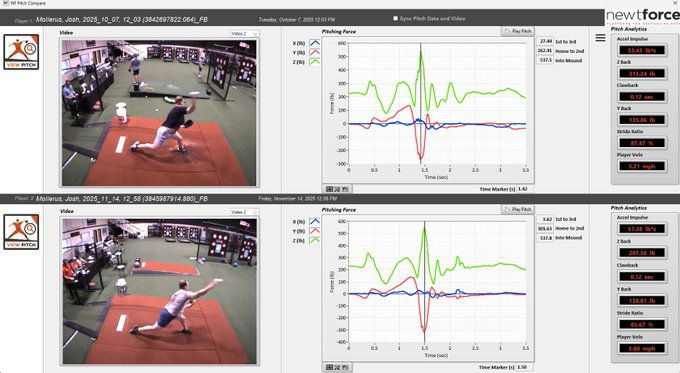
Same pitcher, five weeks apart, two very different force signatures.
The Training Plan
Randy kept the athlete focused on constraints. Aquabag and aquaball work. Hip hinge and hip lock progressions. Pelvic closure drills. Abdominal slack regulation. Every drill built around one goal. Stabilize the back leg so the rest of the delivery had a foundation to work from.
No chasing metrics. No program hopping. Just focused work on the movement that mattered most.
What Back Leg Pitching Mechanics Control
When the back leg is stable and timed well, the pitcher can load, hold, and transfer force into the ground with clarity. The whole transition from hinge into hip lock becomes more organized. Command and stuff follow.
This lines up exactly with what we see on the NewtForce mound. When the trail leg works right, impulse climbs, the curve is smoother and slightly wider, the toe bump is cleaner, and the internal rotation timing improves. It is the foundation of real pitching development.

Five Weeks Later, the Data Confirmed It
The NewtForce metrics told the story Randy’s eye had already seen.
Impulse climbed and the curve smoothed out and widened. The X force golf toe bump cleaned up. Trail hip internal rotation timing improved. The transition from hinge into hip lock became more organized. A better pattern was taking shape.
Then the ball data followed.
Release height dropped three inches. Extension increased 4 inches. Spin rate jumped. Spin efficiency climbed to 100%. Induced vertical break climbed three inches. Strike rate climbed from 20% percent to 60% percent.
That is real development. It did not come from chasing numbers. It came from fixing the movement that creates the numbers.
Movement Creates the Data
Randy said it best. Movement creates the data. Not the other way around.
This is why coaches like Randy use tools like the NewtForce mound to track how the back leg loads, stabilizes, and releases force. The data gives you fast feedback so you can connect the dots between movement and ball flight. When you understand the starting point, you change everything that comes after it.
Youth pitchers. College arms. Pro guys. It all starts the same way.
The Takeaway
Randy deserves the credit here. Smart plan. Smart coaching. Strong results. We are lucky to support coaches who push the field forward.
And here is what matters for you. The next time you see command issues or inconsistent stuff, look down before you look up. The answer might be in the back leg. If you can spot it early, stabilize it smart, and give it time to organize, the results will follow.
Just ask Randy.


